7th May 2026 Worldwide Day of Genital Autonomy 14th Anniversary of the "Cologne Ruling"
Meeting point:
Saturday, 9th of May 2026, 11:00 a.m. - Roncalliplatz
Central rally with speeches:
12:00 p.m. Roncalliplatz
Online:
Live-Stream directly from Cologne and pre-produced videos from 11:00 a.m.
The list of speeches planned so far in the live stream and the central rally can be found here [link to follow].
Further posts after announcement on www.genital-autonomy.de, YouTube and Facebook.
FURTHER DATES:
Friday, 8 May, 6.30 pm
Gläserne Werkstatt (Solingen)
‘Focus Day: Genital Autonomy’ (org. "Fokustag Genitale Selbsbestimmung")
Free entry!
Link to the event
To donate to WWDOGA, please click here:
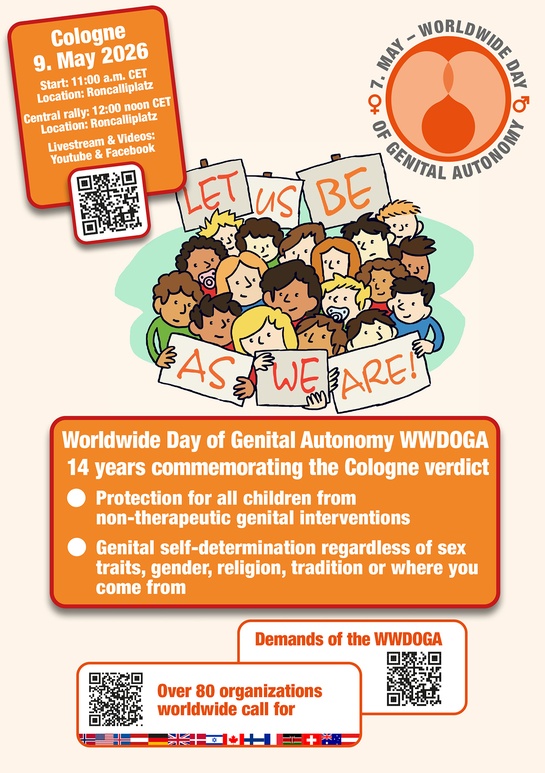
You can check out this year's Flyer here.
This will be the fourteenth anniversary of the "Cologne Ruling". In 2012, for the first time, a court explicitly granted boys the right to genital self-determination by concluding that medically unnecessary foreskin removal ("circumcision") from a boy is an offense. This decision has since become a worldwide beacon for the self-determination of children regardless of gender, ancestry or religion.
List of supporters of WWDOGA 2026
This year's main focus: GENITAL AUTONOMY and the social environment!
For WWDOGA 2026, we are highlighting genital autonomy within our social circles. Many affected by irreversible non-consensual genital procedures suffer in silence due to social, cultural, religious, or institutional pressure.
How does this pressure affect us as a society?
Taboos around intimacy often create insecurity and isolation, causing stress within partnerships and families, especially regarding sexuality or the protection of our children.
Is there a way forward?
Experience shows that openness can bring relief. Speaking up fosters solidarity and raises vital awareness for children's rights. WWDOGA 2026 invites you to consciously engage in these courageous conversations. Together, we can turn taboo into empowerment.
The "Worldwide Day of Genital Autonomy" calls for:
- Adherence to and implementation of the UN-Convention on the Rights of the Child, Article 2 (protection against discrimination); Article 3 (precedence of children's well-being); and Article 24 Paragraph 3 (abolishment of traditional practices prejudicial to the health of children).
- Legislative initiatives worldwide that provide for the protection of all children, regardless of gender, from non-therapeutic genital operations.
- Protection of children with atypical sex characteristics from genital surgery and intervention without absolute medical indication.
- An immediate stop to group or mass circumcision of minor males (boys) for alleged HIV prevention particularly in African countries.
- Public research and education on the consequences of non-therapeutic genital surgery on children in its different forms and social contexts.
 |
 |
When will girls finally be protected?
According to the WHO, female genital mutilation refers to all practices in which the outer genitalia are partly or completely removed, as well as to all other injuries to the female genitalia that are not medically indicated. Depending on the motives and category of cutting, the intervention leads to medical, psychological, social and economic consequences. The practice is, in every form, internationally recognized as a serious human rights violation and is still practiced worldwide: in 29 countries in Sub-Saharan Africa, as well as in South, Southeast and Central Asia, as well as in Europe, the US and Canada. Particularly in Asia, the number of surgeries done by medical staff are increasing, leading to repeated calls for legal acquiescence - which clearly contradicts the WHO.
Boys own their own genitals, too
The trivializing term “circumcision” stands for the amputation of the foreskin of the penis, which involves the loss of approximately 50% of the entire penile skin - including the parts most sensitive to sexual stimulation - and irreversibly alters the natural physiology of the penis and its appearance. Possible psychological long-term effects are increasingly being documented. Total foreskin removal is medically avoidable except in very rare cases. A snug or non-retractile foreskin does not constitute a medical condition in children and adolescents if the boy has no painful obstruction, which is a rare condition. Usually, the opening becomes wider by the end of puberty. In instances of an actual medical condition, most cases can be treated non-invasively.
Suffering and trauma of intersex children due to genital surgery without their consent
One or two out of every 1000 children are born with "atypical" sexual characteristics. Time and again this has led to early genital operations to “assign” a gender, and to hormonal treatments before the capacity to consent. The affected persons often report feeling altered and resentful that their input was never sought out about their own sex. All German paediatric associations currently recommend delaying those measures to an age where the person affected is able to give informed consent. At the international level, as well, the technical discussion is moving in this direction. However, physical integrity and self-determination must still be integrated into practice in many places. For 20 years, the people affected have been publicly protesting these surgeries, which they describe in terms of fundamental human rights violations, as being traumatising and as destructive to sexual sensation. These are allegations that are also backed by human rights committees like the United Nations Committee on the Rights of the Child (UN CRC).
Discrimination against transsexual people
Trans* people often want to match their physical characteristics to their true gender by surgery. If a vulva is to be formed from a penis without the foreskin, ideal tissue is missing to a considerable extent.
The Cologne Ruling
On May 7th, 2012, the Regional Court of Cologne ruled that a non-therapeutic "circumcision" of a boy who is unable to give consent qualifies as an assault. This was widely misinterpreted by many to be a "ban" when in fact it was logically consistent with the law that, in Germany, all children have rights to an unharmed body and a non-violent upbringing – so why should these rights exclude genitalia, and exclusively male ones at that? However, in a rushed response to the Cologne ruling, the German Bundestag decided on 12.12.2012 – that parents can assent for any reason to a "circumcision" of their boys – by codifying the practice into law. This is a complete contradiction to the full legal protection of children and is discordant with the UN Convention on the Rights of the Child in multiple ways.
Our info-page can be found HERE. It contains onward links to specific literature from Germany, Turkey, the USA and other countries; case histories of affected people; films; educational books and brochures; and videos from speeches by international scientists.
There is no room for hatred and misanthropy!
We urge all participants to clearly distance themselves from generalizations and animosity and to be absolutely clear that this is solely about the well-being, bodily integrity, and right to self-determination of children.